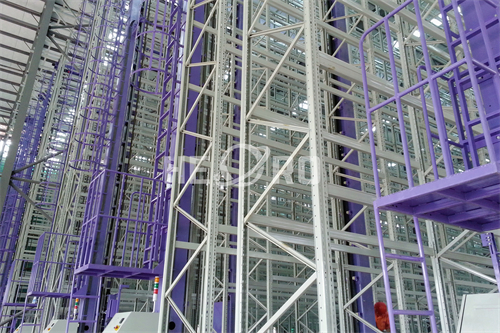
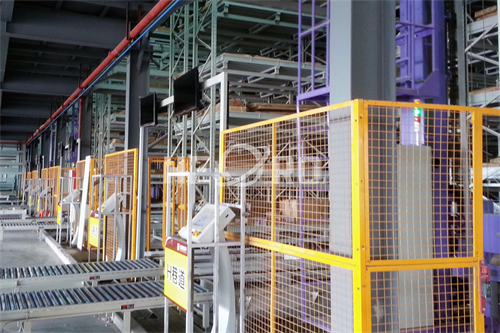
Amid the wave of intelligent manufacturing transformation and upgrading, automated warehouses (AS/RS systems) have become critical infrastructure for smart factories to achieve logistics digitization and high storage efficiency. As a complex system integrating high-rise racking, rail-guided stacker cranes, intelligent control systems, and warehouse management systems (WMS), automated warehouses break through the limitations of traditional storage space and reliance on manual labor, establishing a new logistics system characterized by “space intensification, operation automation, and intelligent management.”
The core competitiveness of automated warehouses stems from the synergistic empowerment of multiple technologies. Their primary structure comprises high-rise racking systems, rail-guided stacker cranes, inbound/outbound conveying systems, and electrical control units. Integrated with WMS alongside ERP and MES systems, they achieve deep connectivity, enabling closed-loop control across the entire process from order placement to material handling. Classified by structure, they include integrated and separated types. By access method, they encompass unit-rack and mobile-rack configurations, adapting to diverse scenarios like parts storage and bulk material handling. They particularly align with smart factories' demands for multi-SKU, high-turnover warehousing.
Compared to traditional warehousing, automated warehouses deliver three core benefits to smart factories. In spatial utilization, vertical space development enables over tenfold increases in storage capacity within the same footprint, significantly reducing land occupancy costs. In operational efficiency, intelligent equipment like rail-guided stacker cranes and four-way shuttles achieve inbound/outbound speeds of hundreds of boxes per hour, boosting storage turnover efficiency by over 200% while minimizing human error rates. In management precision, RFID and digital twin technologies enable real-time material tracking and dynamic inventory management, providing data support for lean production.
Currently, automated warehouses are evolving toward modularity and flexibility. Modular design allows flexible expansion to accommodate production capacity growth, aligning with phased construction requirements of smart factories. The integration of technologies like “goods-to-person” picking and machine vision inspection further breaks down barriers between warehousing and production processes. From the tobacco industry to manufacturing, automated warehouses have become a key driver for enterprises to reduce costs, enhance efficiency, and strengthen core competitiveness, propelling smart factories toward comprehensive, end-to-end intelligent development.