Against the backdrop of limited land resources and rising labor costs, the efficiency bottlenecks of traditional warehousing models are becoming increasingly apparent. With core advantages such as high space utilization, high operational efficiency, and low operating costs, smart automated warehouses have become the preferred choice for warehousing upgrades across various industries, including manufacturing, e-commerce, and pharmaceuticals. They help businesses achieve digital transformation of their supply chains and enhance their core competitiveness.
Operating on the core principle of “maximizing vertical space and optimizing internal efficiency,” intelligent automated warehouses break through the limitations of traditional flat-floor warehousing. Compared to traditional warehouses, intelligent automated warehouses utilize multi-level shelving designs combined with automated stackers, AGVs, and other equipment. On the same floor area, they can achieve 3 to 5 times the storage capacity of traditional flat warehouses, with space utilization rates exceeding 80%. This effectively addresses the pain point of limited warehouse space for enterprises and significantly reduces land usage costs.
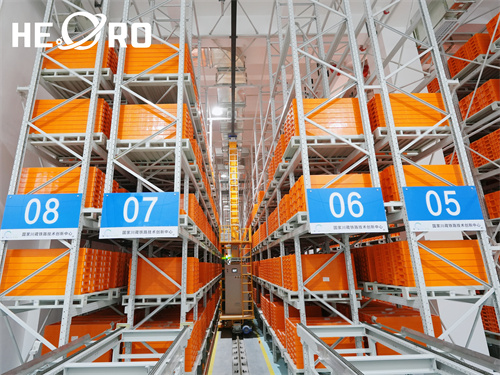
End-to-end automated operations represent another key advantage of intelligent automated warehouses. Leveraging the intelligent scheduling of WMS (Warehouse Management System) and WCS (Warehouse Control System), these facilities achieve fully automated processes for goods intake, shelving, picking, outbound shipping, and inventory counting—all performed unmanned. This not only eliminates human error and boosts picking accuracy to over 99.99% but also increases operational efficiency by 5 to 10 times compared to traditional warehouses, enabling seamless handling of high-frequency inbound and outbound scenarios such as e-commerce sales events and bulk orders.
Optimization of long-term operational costs makes the automated vertical warehouse a key tool for enterprises to reduce costs and improve efficiency. It can replace over 80% of frontline warehouse staff, significantly reducing expenses such as labor wages and training costs. At the same time, through refined inventory management, it prevents stockpiling and expiration of goods, thereby reducing inventory capital tied up. Additionally, its modular design offers strong scalability, allowing for flexible expansion to accommodate business growth without the need for repeated construction, further lowering long-term operational costs.
Today, automated high-bay warehouses are widely adopted across various industries, from material storage in manufacturing to inventory turnover in e-commerce, and from batch management in pharmaceuticals to precise storage in cold-chain logistics. In the future, as intelligent technologies continue to advance, these warehouses will undergo continuous evolution, providing enterprises with more efficient, accurate, and eco-friendly warehousing solutions, thereby propelling the warehousing industry into a new era of intelligent and intensive development.